THE VAMPIRE BOY
There are houses that sit on the earth, and there are houses that grow out of it. Leo's was the second kind.
Joey noticed it every time he came here, though he could never have said it aloud without sounding ridiculous. The Victorian mansion rose from the hillside as if the land had pushed it up through its own skin—dark stone, peaked gables, windows like half-shut eyes watching the tree line. The property sprawled outward in all directions, swallowed by woods on three sides and anchored on the fourth by a gravel driveway that wound down to the county road. In daylight it was merely old. At dusk, with the last copper light bleeding out of the sky and the oaks going black against it, the house looked like something that had been here before anyone thought to build.
Joey crossed the yard with his hands shoved deep in his jacket pockets, backpack slung over one shoulder. The fall leaves were thick underfoot—not the crisp, pleasant crunch of early October but the wet, compressed mat of a season already beginning to rot. The air smelled of woodsmoke and cold earth. He could hear the party before he saw it: bass thumping from somewhere below ground, laughter carried on a wind that moved through the trees like breath through teeth.
The cellar entrance sat behind the mansion, a stone stairway descending into the hillside, its heavy wooden door propped open with a cinder block. Orange light spilled up the steps. Joey paused at the top, adjusted the strap of his backpack, and tried to assemble his face into something that looked like confidence.
This was supposed to be his night. He'd been telling himself that for two weeks—ever since Leo had leaned over in study hall and said, Party at mine, parents in Palm Beach, don't be a bitch about it. Joey had spent the intervening days cycling through every possible version of the evening, most of them ending with him saying something clever to Meggi Carlisle and her laughing in a way that meant she saw him, actually saw him, not the quiet kid who sat in the back of every class and vanished into the walls.
He went down the stairs.
"Yo, you made it." Leo materialized out of the amber gloom, grinning wide, already glassy-eyed. The cellar was all exposed stone and low ceilings, repurposed for the night with string lights and Leo's Bluetooth speaker pumping dance music into the close air. Cases of Bud Light stood stacked in the corner like sandbags against the dark.
"My bad." Joey slipped the backpack off, unzipped it, and produced a fifth of tequila. "Wesley's brother took forever."
"Oh, hell yes." Leo snatched the bottle and held it up to the light like a trophy. "Alright, we're in business. I already set up the beer at the fire pits. Come on—let's get them lit before everyone shows up."
The property had three bonfire pits arranged around the mansion at rough compass points, sunk into clearings where the woods thinned. No one knew why Leo's family had built three. Leo claimed his grandfather had been "into astronomy or some shit," but the pits predated even that. They were old, lined with blackened fieldstone, and when all three were burning they threw a ring of light around the house that made the darkness beyond seem deliberate, as if it had drawn back to watch.
They lit them one by one. The kindling caught fast in the dry air, and by the time they circled back to the cellar, the first cars were pulling up the gravel drive. Joey felt the familiar tightening in his chest as voices multiplied—people streaming through the yard, calling to each other, bottles clinking. The girls arrived in clusters, dressed for the cold in ways that defied it, perfume cutting through the woodsmoke. The cellar filled. The music got louder. Joey found his corner.
He stood there with a beer he wasn't really drinking, watching the room the way you watch a television show you've wandered into halfway through—following the plot, understanding the characters, but unable to shake the feeling that none of it was meant for you. Leo caught his eye from across the room and wove through the crowd, leaning in close enough that Joey could smell the beer on his breath.
"Dude. Chill. You're freaking me out with the wallflower routine. She'll be here. Go talk to someone."
Joey gave him a thumbs-up that felt like a lie and pushed off the wall.
He'd barely made it to the nearest group when the energy in the room shifted. Meggi came down the stairs with her hair loose, which was wrong—or rather, unfamiliar. At school she kept it pulled back in a tight ponytail, efficient, serious, like everything about Meggi Carlisle was calibrated for function over form. Tonight it fell past her shoulders, catching the string lights, and Joey's carefully rehearsed opening line evaporated like spit on a hot stove.
Leo, graceless and grinning, stumbled over to her immediately and said something in her ear. Meggi laughed—the tolerant, eye-rolling laugh of someone used to Leo's nonsense—and then her gaze swept the room and landed on Joey. Their eyes met. She didn't look away.
Joey's stomach dropped through the floor.
Before he could decode what her expression meant, Leo clambered onto a table, sloshing beer, and bellowed: "Alright—party's started! Three bonfires, one legendary night—let's go!"
He tried to jump down, caught his foot on the edge, and went face-first into the packed dirt floor. The room erupted. Even Meggi was laughing, hand over her mouth, and in the chaos of everyone surging toward the door, Joey lost sight of her.
He let the crowd carry him out into the night.
The bonfire at the south pit was the largest, ringed by the loudest contingent—people shouting over each other, someone's phone blasting a competing playlist, the fire so big it turned the surrounding trees into a flickering theater of shadow. Joey drifted past it, drawn by the quieter darkness beyond. He told himself he was looking for a better vantage point. He told himself a lot of things.
He stopped at the edge of the yard, where the mowed grass gave way to the wild growth of the woods. The air was different here—colder, denser, carrying a mineral smell like wet stone. Behind him, the party roared. Ahead, the trees stood in close ranks, their bare upper branches interlocking against the sky like the bones of clasped hands.
Something was standing in the tree line.
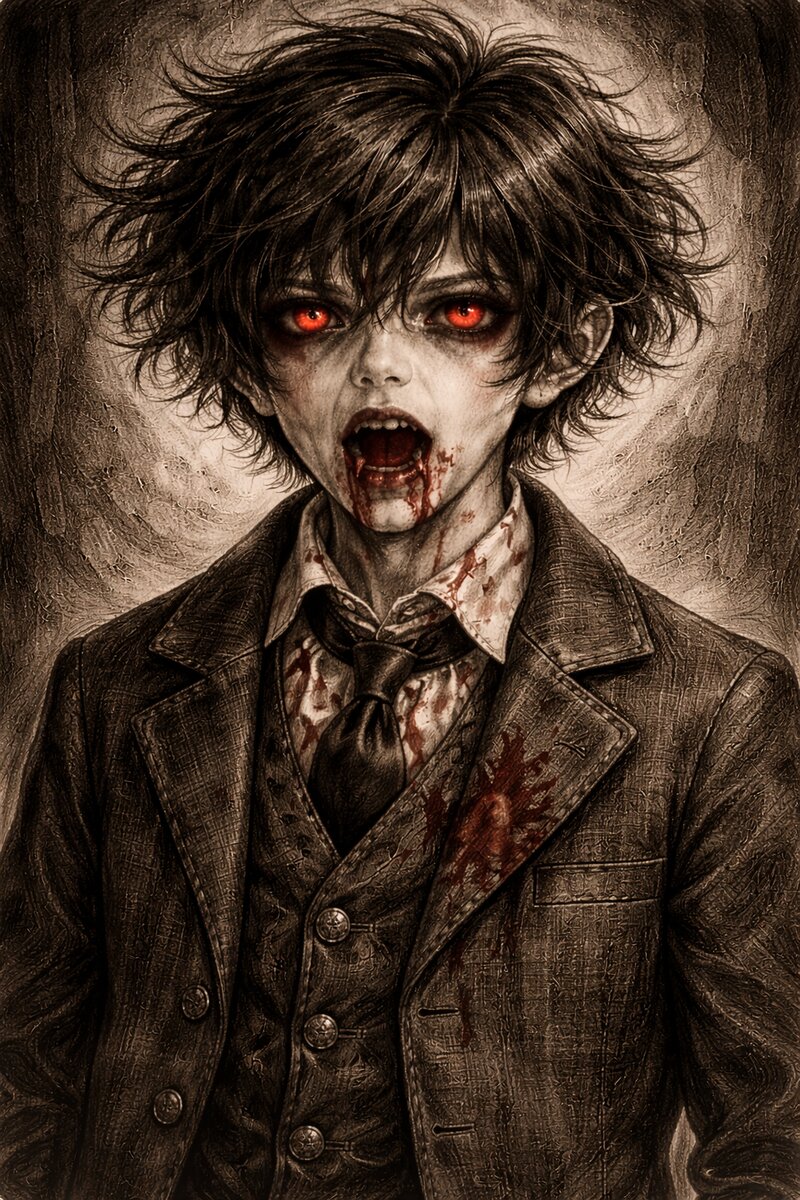
Joey's breath stopped. For a moment his brain refused to process what his eyes were reporting: a small figure, motionless, perhaps thirty yards into the wood. A child. The moonlight found the shape in pieces—a white face, thin arms at its sides, clothes that seemed oddly formal, as if the child had wandered out of a very old photograph. The skin was wrong. Too pale, almost luminous, like something that had never seen the sun.
The child was looking directly at him.
Joey stood paralyzed, every nerve in his body firing a single, wordless alarm. The figure did not blink. Did not shift its weight. Did not breathe, as far as Joey could tell. It simply watched him with an attention that felt physical, like fingers pressing against his skin.
Then it smiled.
The smile was too wide. It stretched across the child's face with a slow, mechanical quality, as if the muscles responsible had forgotten how the expression was supposed to work and were improvising. It was the smile of something wearing a child's face the way you'd wear a mask—close enough to pass at a distance, but deeply, fundamentally wrong up close.
Joey blinked. A single blink, involuntary, the kind your body does when it's overloaded and needs to reboot.
The child was gone.
Not retreating, not fading—gone, as if it had been painted on the air and someone had wiped the canvas clean. The trees stood empty. The moonlight fell on nothing. The woods exhaled their cold, mineral breath and said nothing at all.
Joey stood there, heart slamming, for what felt like a very long time.
Neighbor kid. Just some weird neighbor kid spying on the party.
He repeated it until the words lost meaning, which didn't take long, because the image of that smile was already lodged behind his eyes like a splinter, and no amount of rational explanation could account for the way it had made him feel: not just scared, but recognized. As if the thing in the trees had been waiting specifically for him, and was pleased he'd finally arrived.
"Earth to Joey."
He spun. Meggi stood a few feet away, arms loosely folded, head tilted, firelight catching the edges of her hair. She was smiling, but the teasing quality of it faded as she read his face.
"Hey. You okay?"
"Yeah. Yeah, I just—" He ran a hand through his hair, realized it was shaking, and shoved it back in his pocket. "I thought I saw someone. Out in the trees."
Meggi's eyes moved to the wood line, scanning with a sharpness that surprised him. The playful expression was gone. "Someone like who?"
"A kid. I don't know. Standing there, just… watching."
She studied the darkness for another moment, then looked back at him. "Probably just someone trying to crash the party," she said, but her voice had a thinness to it, like a wire drawn too tight.
"Yeah. Probably."
A beat of silence. Then Meggi moved closer, and her voice dropped. "This place gives me the creeps. Has since I got here."
Joey exhaled. He hadn't realized how badly he'd needed someone else to say it. "It feels old," he said, grasping for the right words. "Like it's holding its breath."
Meggi's eyes sharpened with interest. "That's exactly right. Like the whole property is just… waiting for something."
They stood together at the boundary between the firelight and the dark, and for a moment neither of them spoke. The party thumped and howled behind them. The trees were silent ahead.
"Well," Meggi said, "if it's watching, it can't have us if we stick together. Deal?"
She bumped his shoulder with hers. It was a small gesture, but Joey felt something loosen in his chest—a knot he'd been carrying for weeks, maybe longer.
"Deal," he said.
They turned their backs on the tree line and walked toward the light.
But the darkness stayed where it was, patient and very old, and it watched them go with something that was not quite hunger and not quite love but lived in the crawl space between the two, waiting, as it had always waited, for the night to deepen and the fires to burn low.
By ten-thirty the main bonfire had become a spectacle—a trembling column of heat and light that threw the surrounding trees into sharp relief and turned the faces of the people around it into something almost tribal, painted in amber and moving shadow. The noise of it carried across the property in waves: laughter, shouting, the tinny pulse of someone's speaker competing with the wind.
Joey and Meggi had gone the other way.
The northern pit was the smallest and the most remote, tucked into a clearing where the tree line curved close on three sides. A handful of people had drifted through earlier but had moved on, drawn back to the larger fire and the louder crowd. Now the pit held only its modest flame and the two of them, seated on flat-topped stones that someone had dragged into position years ago, the fire between them like a shared secret.
Joey gestured with the tequila flask, realized his palm was embarrassingly damp, and set it on the ground between them. "This one's got the best view," he said, then winced internally at how much he sounded like a real estate agent showing a condo. "The trees block the wind."
Meggi settled onto the opposite stone, tucking one leg beneath her. She'd borrowed someone's oversized denim jacket—Leo's, probably—and it swallowed her shoulders, making her look smaller and somehow more present at the same time. "It's definitely quieter," she said. Her eyes lingered on his a beat too long, then cut to the flames.
The fire crackled. Joey's brain shuffled through a deck of possible conversation starters, all of them terrible, so he played the first card that surfaced: "So. You're into history?"
Meggi snorted, caught herself, and pressed her lips together. "Is it that obvious?"
"Not really," he lied, then decided honesty might serve him better. "Okay, a little. I heard you in chem lab going off about some urban legend. The White Lady of Old Kingston? It sounded like you were debunking it."
Her eyes lit up—actual light in them, independent of the fire. "I wasn't debunking. I was correcting. Everyone tells the romantic version. The real story is way worse." She reached into the jacket pocket and produced a battered steel thermos, unscrewed the cap, and offered it to him. "Apple cider. Unspiked. I figured I'd need something warm if I was going to survive a party at a haunted house."
Joey took it. Their fingers brushed. He tried not to make it weird. "You want to tell me the real story?"
Meggi glanced at the fire, then past it, toward the trees, as if checking whether the darkness was listening. "It's not exactly party conversation."
"That's fine. I'm not exactly a party person."
She studied him for a moment—not judging, just reading—and something in her expression softened. "Okay. So the original White Lady wasn't a ghost bride or a heartbroken lover or any of that Hallmark stuff. She was the nursemaid for a wealthy family. The house burned in the 1830s—full blaze, middle of the night. The family died inside. Neighbors said she'd set the fire, but nobody could prove it. She was the only survivor."
"Jesus."
"It gets worse. People said she haunted the ruins afterward, wandering through the foundation at night, calling for the children. But if you go back and read the actual newspaper records from the county archive—and I have, because I'm that person—they never found her body. Nobody ever saw her leave. The last thing anyone reported was a smell coming from inside the walls. Something rotten. Something that had been there a long time." Meggi leaned forward, elbows on her knees, voice barely above the crackle of burning wood. "Like she'd never left the house at all. Like the house had just… kept her."
The hair on Joey's arms stood straight. He became aware, in the way you become aware of your own breathing when someone mentions it, of how quiet the clearing had become. Not silent—the other bonfires still roared in the distance—but muffled, as if the trees had leaned in closer to listen.
"That's way creepier than the version I heard," he said, his voice coming out higher than he wanted.
"It always is. People turn every old tragedy into a love story because the alternative—that terrible things happen for no reason, that places can soak up suffering like a sponge and hold it—is too much. It's easier to believe in ghosts than to accept that sometimes the house itself remembers." She caught herself, blinked, and shot him a sidelong look. "Sorry. I get like this around fires."
Joey laughed. It sounded rusty, almost startled, like a door being opened for the first time in months. "If this is you being a nerd, I'm in trouble. I spent the whole day googling how to make small talk."
"What'd you learn?"
"Nothing useful. Apparently you're supposed to ask about favorite movies, but then you risk finding out someone's favorite movie is The Notebook, and where do you go from there?"
She tilted her head back and laughed—a real one, full-throated, her loose hair catching the wind. "I promise I will never subject you to The Notebook. Unless we're watching it in a haunted house. Then it's thematically justified."
He grinned. The knot in his chest loosened another turn. "What's yours, then? Favorite movie?"
She considered it, sipping from the thermos. "The Others. The one with Nicole Kidman. It's not about the scares—it's the atmosphere. The way the house feels like a character. You spend the whole movie thinking you understand the rules, and then the ending pulls the floor out."
"Yeah," Joey said, and meant it. "The atmosphere's always the scariest part. Not the monster. The feeling that something's wrong before you can name it."
She looked at him with an expression he couldn't quite decode—surprise, maybe, or recognition. "Exactly."
They passed the thermos back and forth as the conversation unwound, easy and meandering, touching on sleep paralysis, childhood nightmares, the best Halloween costumes they'd ever seen, the particular terror of a house that creaks when no one's walking. Joey told her about the time his grandmother had described the haunted wallpaper in an old Victorian mansion—a pattern that was supposed to drive anyone who stared at it long enough slowly mad. Meggi told him about the time she'd spent an entire weekend in the county archive reading century-old coroner's reports and her mother had staged what amounted to a gentle intervention.
The fire pulsed between them, painting everything in shades of amber and shadow. Occasionally a gust of wind would scatter sparks into the air, and Joey watched them rise and vanish against the stars, and for a few minutes at a time he forgot about the thing in the trees entirely.
Then the wind would shift, and the shadows would stretch, and his body would remember what his mind was trying to forget.
"You think Leo's place is haunted?" he asked during a lull, nodding toward the mansion on the hill. Its silhouette was visible through the thinning trees—dark gables against a darker sky, the windows catching just enough firelight to look like they were watching.
Meggi studied the house with the careful attention of someone examining evidence. "Not haunted," she said slowly. "Haunting implies something from outside came in. I think it's more like… places remember things. Especially places where nobody ever bothers to forget."
Joey exhaled. His breath smoked in the cold air. "I keep thinking about that kid I saw. I know it sounds insane."
"Tell me again. Exactly what you saw."
He described it: the impossible paleness, the stillness that went beyond motionlessness into something more fundamental, like the child had been placed there rather than having arrived. The smile that stretched too wide, too slow, across a face that didn't move in any of the small, unconscious ways that living faces move.
"It was like looking at a photograph," Joey said. "Something flat. Something that was already there before I showed up, and would still be there after I left."
Meggi didn't laugh. Didn't dismiss it. She sat very still, her hands wrapped around the thermos, and stared into the fire with an expression Joey recognized because he'd seen it earlier—in chem lab, when she was working through a problem, sorting possibilities, eliminating variables.
"Could've been a neighbor's kid," he added, hearing how weak it sounded.
"Maybe," Meggi said. "But the way you described it—it sounds like he was waiting."
They let the thought sit between them, neither willing to follow it to wherever it led. The fire popped. An owl called once from deep in the trees, and nothing answered.
Joey poked a stick into the coals and watched the tip glow red. "Is this the part of the night where we're supposed to tell ghost stories?"
Meggi's mouth curved. "We've been telling them for an hour. We just haven't admitted it yet."
He looked at her—the firelight in her eyes, the way she held herself like someone who was always a little bit braced for the world to surprise her—and felt, for the first time in as long as he could remember, that he was exactly where he was supposed to be.
"You're not nearly as scary as I thought you'd be," he said.
She raised an eyebrow. "Give me time."
They laughed together, and this time it didn't sound like two strangers making noise. It sounded like a beginning.
Leo arrived the way Leo always arrived—loudly, a little off-balance, and convinced he was making an entrance. He emerged from the gap between the trees with his silhouette stretched long against the firelight, a beer bottle cradled between his knees before he'd even sat down.
"You two keeping warm over here?" he called, dropping heavily onto a log that groaned under his weight. His grin was wide but brittle, the grin of someone working hard to project a version of himself that the alcohol was slowly peeling away.
"Only way to survive," Meggi said, warmth in her voice.
Joey raised the tequila flask in mock salute. "We were about to summon your family's ghosts. You're just in time."
Leo laughed—too hard, too fast—and his eyes darted toward the mansion on the hill. He peeled a strip from his beer label, rolled it into a tight coil, and flicked it into the flames. The gesture had an anxious, repetitive quality, like something he'd been doing all night without realizing it.
"If you find any, tell them to leave the wine cellar unlocked," he said. But his voice had gone flat, and the silence that followed had weight.
Meggi leaned forward. "What's the deal with your place, Leo? Has your family ever talked about the history?"
Leo shrugged, tearing another strip. "My parents don't talk about it. Like, at all. Total stonewall. I've asked—believe me, I've asked—and they just change the subject or hit me with the 'you wouldn't understand' line. Which, coming from people who spend half their lives in Palm Beach pretending this house doesn't exist, is rich."
"But they bought it," Joey said. "Why buy a house like this and then refuse to talk about it?"
Leo took a long pull of his beer, staring into the fire. "Image. Old money, old property, old name on the mailbox. My parents want to own history, not learn from it. Too bad the house doesn't care what they want." He looked up at the mansion windows—black glass, reflecting nothing. "I think the house remembers plenty, whether anyone asks or not."
The fire shifted, a log collapsing inward, and in the rearrangement of light and shadow, Leo's face looked older, harder, stripped of the easy charm he wore like a costume.
Meggi's voice was careful. "Have you ever seen anything? Here on the property?"
Leo hesitated. Joey watched the hesitation travel through him like a current—a tightening of the jaw, a stillness in the hands—and understood that whatever Leo was about to say was something he'd been carrying for a while.
"Once. Last winter." His voice was low, directed at the fire rather than at them. "I was home alone. It was late—two, maybe three in the morning. I heard something outside. Not an animal. A kid. Crying."
The wind moved through the trees. None of them spoke.
"I went out. I don't know why—you'd think growing up in this house would've cured me of going toward weird noises in the dark. But it sounded so real. So close. Like a child was standing right outside my window." He paused. "I searched the yard. Nothing. Went into the tree line with a flashlight. Nothing. But the snow—" He stopped. Started again. "The snow had footprints in it. Small ones. A kid's. They led from the woods toward the house, and then they just… stopped. In the middle of the yard. Like whoever made them had been erased. Or pulled straight up."
He picked up his beer, looked at it, and set it down again without drinking. "I went back inside and locked every door in the house. Didn't sleep till sunrise."
For a long moment the only sound was the fire and the wind and the distant, muffled bass of the party carrying through the cold air.
Then, from somewhere in the trees to the east, a shout—high, abrupt, and cut short. Not a word. A sound. The sound a person makes when surprise becomes fear before the brain has time to assign it language.
All three of them went rigid.
"What the hell was that?" Joey's voice came out tight.
Leo scanned the tree line, bottle gripped in white-knuckled fingers. "Mike screwing around. Or Wes. He does this at every party." But he didn't move. Didn't stand.
Meggi shook her head slowly. "That didn't sound like a prank."
A second sound—fainter, more distant, less like a shout and more like a question being swallowed by the dark. Then nothing. The silence that followed was the wrong kind of silence, the kind that fills a space where sound should be.
"We should check it out," Joey said, and immediately regretted it.
Leo's grin returned, but it was a mask now, and everyone knew it. "Sure. Let's go play heroes. Ten bucks says it's Wes with a rubber mask." He stood, swayed slightly, and stared at the tree line like a man looking at water he wasn't sure he could swim.
Meggi stood too. She met Joey's eyes. The look she gave him wasn't fear, exactly—it was assessment. Calculation. The same expression she wore in the archive, sorting evidence, preparing for what came next.
"Safety in numbers," she said.
They moved together toward the trees, the warmth of the fire falling away behind them like a coat slipping off their shoulders. The darkness ahead was total, unbroken, a wall of black that seemed to lean toward them as they approached.
Leo blew out a long breath. "My family's owned this land for a hundred years. About time it finally made things interesting."
They stepped into the dark.
The woods gave them nothing.
They walked the eastern path for ten minutes, calling names that the trees absorbed without echo, finding nothing but the usual detritus of a forest in late autumn—fallen branches, the husks of dead leaves, the faint sweetness of decay. Whatever had made the sound was gone, or had never been where they thought it was. Distance and darkness played tricks. They told themselves this.
They circled back to the northern pit, chilled and unsettled, and the fire seemed smaller than when they'd left it—as if it had been slowly exhaling in their absence, letting go of its heat one degree at a time.
Leo went straight for the cooler, cracked a fresh beer, and drained half of it standing up. His hands shook. He noticed Joey noticing and shoved them in his pockets. "Well. That was a whole lot of nothing."
Meggi didn't answer. She'd already settled onto her stone seat and pulled out her phone, the blue-white glow turning her face into something spectral. Her thumbs moved with a focused urgency that Joey recognized as the opposite of casual scrolling. She was hunting.
He crouched beside her. "What are you looking for?"
"Anything about this property. The land. If there's a history, I want to know what we're dealing with." She paused. "Or not dealing with. Probably not dealing with."
Joey said nothing. Probably was doing a lot of work in that sentence.
What Meggi found, scrolling through a county historical society's digitized archives at a pace that would have been impressive in a library and was frankly alarming by firelight, was this: the Howland family had owned the property since the 1820s. The original estate had included a working mill, a smokehouse, and a small family cemetery—long since overgrown—at the eastern edge of the woods. The house had been rebuilt twice, once after a fire in 1847 and again in 1903, each time larger, each time heavier, as if the family were trying to anchor themselves more firmly to land that kept trying to shake them loose.
The records were spotty, but a pattern emerged if you squinted: a child's death in 1823, attributed to fever. Another in 1851, listed as a drowning despite the nearest body of water being a seasonal creek. A third in 1889—cause of death left blank, the coroner's report consisting of a single sentence that Meggi read aloud in a voice stripped of all inflection: "The child was found in the cellar in a condition inconsistent with any known natural cause."
"Found in the cellar," Joey repeated, and the words landed in his stomach like stones.
Leo had gone very quiet. He stood at the edge of the firelight, his back to them, staring at the house. When he finally spoke, his voice was different—thinner, younger, as if the alcohol and the bravado had burned off simultaneously and left behind the seventeen-year-old underneath.
"The cellar," he said. "Every time something weird happens in this house, it's always the cellar."
Meggi looked up from her phone. "What do you mean?"
"The crying I heard last winter—it was coming from the direction of the cellar. The footprints in the snow? They were heading toward the cellar entrance. My grandfather used to keep the cellar padlocked, and when I asked my dad why, he said it was because of flooding. But I've been down there a hundred times and it's never flooded. Not once."
Something moved in the trees.
Not a sound, not a shape—a movement, perceived at the edge of vision, the way you catch the flicker of a bird in your peripheral sight except that this was slower, more deliberate, and when Joey turned to look, there was nothing there. Only the trees, and the dark between them, and the sense—irrational, undeniable—that the dark had just rearranged itself.
Meggi's phone dimmed. She stared at the screen, then at the trees, then at Leo's rigid back. When she spoke, her voice was the voice of someone making a decision they knew they'd regret.
"We should go to the cellar."
"Are you out of your mind?" Joey's whisper was sharp enough to cut.
"Every account points there. Every disappearance, every sighting, every piece of this goes back to that cellar. If there's something on this property—something real—that's where it lives."
Leo turned around. His face in the firelight was a study in competing impulses—fear pulling one way, something older and deeper pulling the other. Pride, maybe. Or obligation. The particular burden of being the boy who lived in the haunted house and had spent his whole life pretending it wasn't.
"She's right," he said. And then, quieter: "I've been avoiding that cellar my whole life. Maybe it's time to stop."
Joey looked at Meggi.
"We can't let him go alone," she said. It wasn't a question.
They followed.
The stone steps descending to the cellar had changed—or perhaps it was only that Joey's perception of them had changed, the way a hallway you've walked a thousand times looks different when you walk it in the dark. The walls seemed closer. The steps steeper. The air that rose from below carried the smell of damp earth and something else, something older and sweeter, like flowers left too long in still water. The music had stopped. At some point during their approach—Joey couldn't have said exactly when—the pulse had ceased, and the silence that replaced it was not the absence of sound but the presence of something else. A held breath. A listening.
Leo reached the bottom first. He stood in the doorway, backlit by nothing, and Joey heard him exhale—a long, slow sound that might have been relief or might have been the first syllable of a word he never finished.
"What the hell," Leo said. His voice was very quiet.
Joey and Meggi reached the bottom of the stairs and looked past him into the cellar.
The room was as they'd left it—string lights still on, though dimmer now, as if the current feeding them had thinned. Cases of beer in the corner. Red solo cups scattered on the floor. Someone's backpack, forgotten. The party's artifacts, still warm, but the warmth was draining out of them the way heat drains from a body.
In the center of the room, the boy stood.
He was exactly as Joey had seen him at the tree line—the same impossible paleness, the same formal, antiquated clothing, the same absolute stillness. Up close, the wrongness of him was more pronounced. His skin had a translucence to it, as if the moonlight had followed him underground and was trapped just beneath the surface, trying to escape. His eyes were dark—not brown, not black, but dark the way deep water is dark, absorbing light and returning nothing. He stood with his hands at his sides, his chin slightly raised, and he watched them enter with an expression of patient, perfect calm.
He did not look like a child. He looked like something very old that had chosen a child's shape the way a hand chooses a glove—for utility, not sentiment.
"Get out of my house," Leo said. His voice cracked on house.
The boy regarded him. The silence stretched.
"I was here before it was a house," the boy said.
His voice was wrong. Not a child's voice. Not an adult's. It was layered, harmonic, as if multiple voices were speaking in near-perfect unison—a choir collapsed into a single throat. It was beautiful in the way that certain things in nature are beautiful: the iridescent sheen on a beetle's back, the geometry of a spider's web. Beautiful, and designed for a purpose that had nothing to do with beauty.
"I was here when they laid the first stones," the boy continued. He had not moved. Had not blinked. "I was here when they buried the foundation in the hillside and told themselves they were building something permanent. I was here when your grandfather's grandfather was a child." A pause. "I liked him. He had a strong heart. It took a long time."
Leo swayed. "You're—you're some kind of—"
"Timothy," Meggi said.
The boy's gaze shifted to her. It moved like a searchlight—slow, deliberate, illuminating everything it touched. Joey felt Meggi stiffen beside him, but she didn't look away.
"Timothy Howland," she said again. "The boy from 1823."
Something crossed the creature's face—not quite amusement, not quite memory. A flicker, like light through water. "Timothy," it said, tasting the name. "He was one of the first. In this house. There had been others before, in the woods, when this was all woods and the only light came from the moon. But Timothy was the first one who came to me willingly. Children do, sometimes. They see something in the dark and walk toward it, because children haven't yet learned that the dark walks back."
Meggi's hand found Joey's. Her grip was ice.
"You're not Timothy," she whispered.
"No." The boy smiled, and it was the same smile Joey had seen at the tree line—too wide, too slow, a crack opening across a face that had been wearing the same expression for two centuries. "I am what Timothy became a part of. What they all became a part of."
Leo lunged.
It was sudden, graceless, the uncoordinated charge of a frightened animal that mistakes aggression for survival. He crossed the three steps between himself and the boy with his fists raised and his jaw clenched and every line of his body committed to the terrible, doomed certainty that size and anger could overcome whatever this was.
The boy didn't move. Not in any way Joey could see. One moment Leo was reaching for him—and the next Leo was standing still, perfectly still, his arms at his sides, his eyes wide and fixed on nothing. The boy's hand rested on Leo's chest. It was a gentle touch, almost parental, the way you'd place your hand on a child's forehead to check for a fever.
Leo exhaled.
It was a small sound—not a scream, not a cry, just a breath leaving a body, the kind of sigh you make when you set down something heavy you've been carrying for a long time. The color drained from his face like water from a basin, starting at the edges and moving inward, his skin going gray, then white, then a translucence that mirrored the creature's own. His eyes lost their focus. His knees buckled, slowly, as if the mechanism that held him upright was being disassembled one bolt at a time.
He folded to the floor in silence.
The boy withdrew his hand. A single drop of something dark—not blood, not quite—fell from his fingertip and was absorbed by the earthen floor as if the ground itself were thirsty.
The string lights flickered once and went out.
In the darkness, the boy's skin gave off a faint luminescence, the pale glow of something phosphorescent stirring in deep water. His eyes found Joey.
"You saw me," the boy said. "At the edge of the trees. You saw me, and you didn't run." He tilted his head, considering. "They usually run."
Joey couldn't speak. His body had locked, every muscle seized, his brain transmitting a single screaming command that his limbs refused to obey. Meggi's hand was still in his, and he could feel her trembling—not the small tremor of fear but the deep, full-body shaking of someone whose nervous system has recognized a threat that the conscious mind is still trying to process.
The boy took a step toward them.
Meggi moved.
She didn't pull Joey—she pushed him, hard, toward the stairs, and the impact broke whatever paralysis had gripped him. His legs responded. His feet found the first step. Meggi was right behind him, her hand on his back, shoving, and then they were climbing, scrambling up the stone stairs on all fours, fingernails scraping the walls, the cold October air hitting their faces like a slap as they burst out of the cellar into the moonlit yard.
"The property line," Meggi gasped. She was already running, dragging Joey by the wrist, pulling him toward the western tree line where the woods thinned and the land sloped down toward the county road. "The article—every account, every sighting, every disappearance—they all happened on this property. On this land. Nothing past the boundary. Nothing past the road."
"You don't know that—"
"I know the pattern. That's all I've got."
They ran. The ground was uneven, treacherous with roots and the slick mat of decomposing leaves. Branches whipped at their faces and arms. The moonlight came and went through the canopy overhead, turning the world into a strobe of silver and black. Behind them, the mansion stood against the sky like a monument to something no one wanted to remember.
Joey risked a glance backward.
The boy was not chasing them. He stood at the cellar entrance, a pale smudge against the dark stone, watching them with the serene patience of something that had never needed to hurry. He had eternity. He had the land. He could wait.
But he was watching. And even across the distance, even through the dark and the trees and the hammering of his own pulse, Joey could see that the boy was smiling.
They crashed through the last line of trees and stumbled down the embankment to the county road. The asphalt was cracked and cold under their hands. A single streetlight buzzed a hundred yards to the south, its orange glow the most beautiful thing Joey had ever seen.
They collapsed at the road's edge, gasping, their breath making twin columns of fog in the cold air. Meggi's phone was still clutched in her hand, its screen cracked from the run. She turned it over and looked at the time: 11:47 PM.
They'd been in the cellar for less than five minutes.
They sat on the gravel shoulder for a long time, neither speaking, both listening. The party was still going—they could hear it, faintly, through the trees. The bass pulse of music. Shouts that might have been laughter.
Then the shouts changed.
It was subtle at first—a shift in pitch, a note of confusion entering voices that had been raised in celebration. Then the confusion sharpened into something else. A scream, high and clear, cutting through the night like a blade through paper. Another. A third, overlapping, rising in a harmony of terror that was almost musical.
Joey stood. "We have to—"
"No." Meggi's voice was raw. Her face was wet—tears, though she didn't seem to be crying so much as leaking, her body processing shock through whatever channel it could find. "We can't go back. You know we can't."
"There are people in there. Our friends are in there."
"And if we go back, we die with them." She looked up at him, and the expression on her face was the worst thing he'd seen all night—worse than the boy, worse than Leo's body folding to the floor—because it was the face of someone making a calculation that no one should ever have to make. "We go back, and nobody gets out. We stay here, and at least someone knows what happened. At least someone can tell people."
The screams continued for another ninety seconds. Joey knew because he counted—because counting was the only thing keeping him on his side of the road, the only barrier between himself and the overwhelming, suicidal impulse to run back up that hill and into the fire and the dark and whatever was happening to the people he'd been laughing with an hour ago.
Then the screams stopped.
The silence that followed was absolute. Not the comfortable silence of a party winding down, of people going home, of a normal night ending the way normal nights end. This was the silence of something finished. Something consumed. A silence so complete it seemed to have weight and texture, pressing against their eardrums like water.
The bonfires were still visible through the trees, flickering against the sky. But nothing moved around them. No silhouettes. No shadows. The fires burned for no one.
Meggi dialed 911. Her hands shook so badly it took her three tries. When the dispatcher answered, she opened her mouth and for a long moment nothing came out—just air, shaped by a throat that had forgotten how to make words carry meaning. Then, very slowly, in a voice Joey barely recognized, she said: "There's been—something happened. At the old Howland property. On Ridge Road. People are hurt. I think people are dead."
She gave the address. She answered questions she couldn't fully understand. She stayed on the line as the dispatcher told her to stay put, help was coming, stay on the line. She held the phone against her ear and stared at the tree line and did not blink.
Joey sat beside her. Their shoulders touched. He wanted to say something—something that acknowledged what had just happened, something that made sense of it, something that would retroactively change the last hour into a bad dream they'd both wake up from. But language had failed him. The only thing left was proximity: the warmth of another body, the proof of another heartbeat, the fragile evidence that they were still alive and the night had not taken them.
Sirens, eventually. Red and blue lights strobing through the trees, painting the world in colors that looked wrong, too vivid, too present. Car doors slamming. Voices calling out in the dark with the forced calm of people trained to walk toward the things everyone else runs from.
Meggi lowered the phone. She looked at Joey. Her face, in the alternating wash of red and blue light, was a thing he would remember for the rest of his life—not because of the terror on it, which was already beginning to calcify into something harder and more permanent, but because of the understanding beneath it. She knew what they'd seen. She knew no one would believe them. She knew that the telling would be its own kind of haunting—a story they'd carry like a stone in their pockets, heavy and smooth and always there, for however long however long turned out to be.
"What do we tell them?" Joey asked.
Meggi was quiet for a moment. The sirens wailed closer.
"The truth," she said. "And then we live with the fact that the truth isn't enough."
The county sent cars and ambulances and, later, cadaver dogs and a forensics team from the state. They found the bonfires still burning. They found the beer and the speakers and the backpacks and the phones. They found evidence that a large number of people had been present and had departed suddenly.
They did not find bodies.
Not in the cellar, where Joey and Meggi said a boy had been standing. Not at the bonfire pits, where the screams had come from. Not in the woods, not on the road, not in the creek that ran along the eastern border of the property. Twenty-three people had attended the party, and twenty-one of them were gone, and the ground had closed over them like water over a stone.
Leo's parents flew back from Palm Beach. There were investigations, search parties, cadaver dogs, a brief and fruitless involvement by the FBI. Joey and Meggi told their story—the pale boy, the cellar, the screams—and were met with the particular brand of gentle disbelief reserved for people who have experienced something too large for the available frameworks of comprehension. Grief counselors were provided. Trauma was acknowledged. The case went cold within six months.
The house was sold. Then sold again. The new owners didn't stay long. Neither did the ones after them.
Joey and Meggi stayed in touch—not by choice so much as by necessity, the way two people who have seen the same impossible thing are bound by it, tethered to each other by a shared knowledge that no one else can hold. They didn't talk about it often. They didn't need to. It lived in the pauses between sentences, in the way they both went quiet when the light changed in a certain way, in the way neither of them could stand near a tree line at dusk without feeling the old chill move through them like a current.
Years later, Joey drove past the property. He hadn't meant to—or hadn't admitted to himself that he'd meant to. The house was dark, uninhabited, its windows boarded, its yard grown wild. The bonfire pits were still there, barely visible through the overgrowth, three circles of blackened stone in a sea of weeds.
He stopped the car at the bottom of the driveway and sat with the engine running, looking up the hill at the place where the worst night of his life had unfolded. The sun was going down. The trees were going dark. The sky was the color of a bruise.
At the edge of the yard, where the mowed grass had once given way to the wild growth of the woods, something pale flickered in the failing light. A shape. A stillness. The suggestion of a face, turned toward the road.
Joey put the car in gear and drove.
He did not look back. He did not need to. He already knew what was there—the same thing that had always been there, before the house and before the stones and before the name on the deed and the legends in the archive. The thing that lived in the land itself, patient and ancient and smiling, waiting for the next fire to be lit and the next voices to rise in the dark.
The trees closed over the driveway behind him. The road unwound ahead, long and empty, and the night came on.